High-Flex Drag Chain vs Standard Fiber Optic USB3.1 Gen2 Type-C Cables: Diameter, Bend Radius and 10-Million-Cycle Life Compared
2026-09-15

Introduction | On industrial cameras, vision inspection stations and automated production lines, two cables both labeled "fiber optic USB3.1 Gen2 Type-C" can differ by half in price. The difference is not bandwidth but mechanical cable construction. Using the KING KABLE fiber optic USB3.1 Gen2 Type-C family as a reference, this article breaks down the technical differences between high-flex drag chain cables and standard cables so engineers can select by duty cycle rather than by price.
1. Identical Electrical Specifications: 10Gbps, 50 Meters, Plug and Play
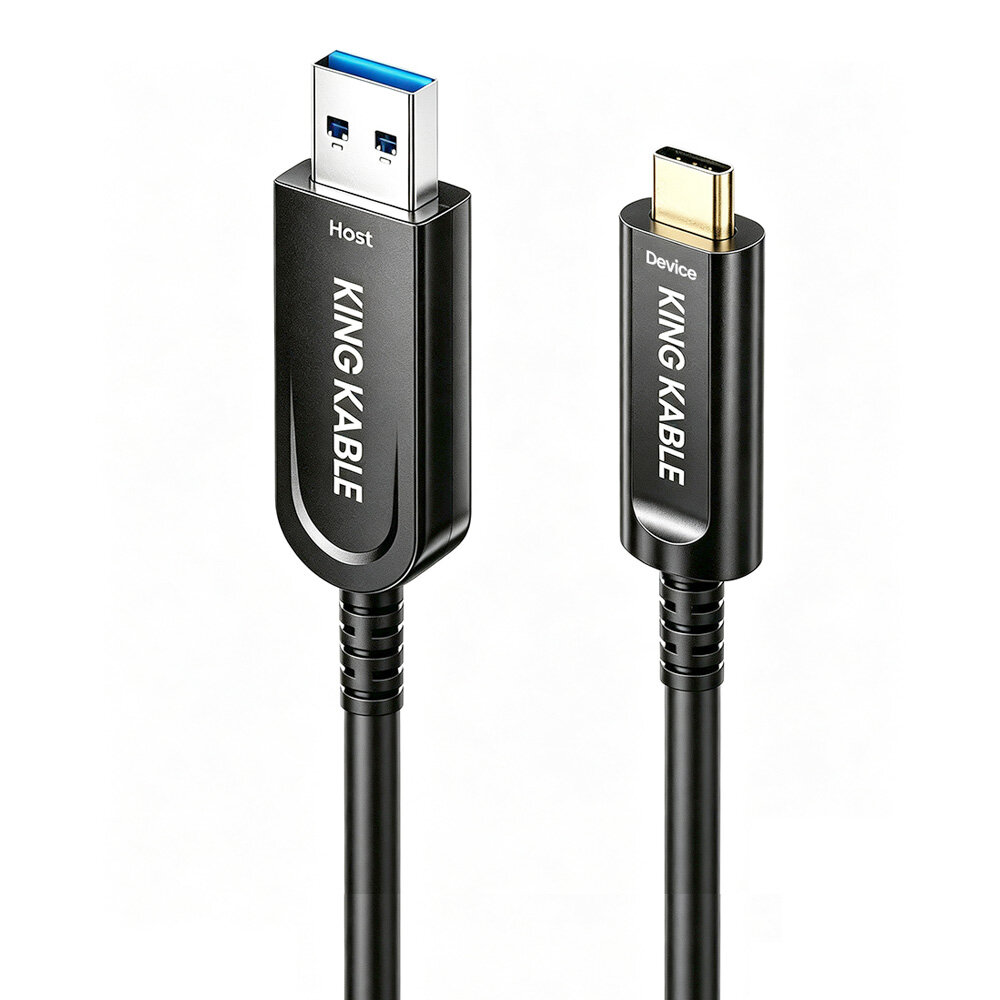
Start with the most misunderstood point: the electrical and protocol specifications are identical. Both fully comply with the USB3.1 Gen2 standard, deliver 10Gbps bandwidth and support 5V charging; both use OM3 10G optical fiber plus copper cores as the transmission body with a built-in optical-electrical conversion engine, and are backward compatible with USB3.1/3.0 (USB2.0 on selected versions); both reach up to 50 meters with no external power and true plug-and-play operation; both support the UVC video protocol for stable connection to industrial cameras and webcams, and work with Windows, Mac OS and Linux.
In other words, choosing a drag chain cable does not increase bandwidth, and choosing a standard cable does not reduce speed. Every difference concerns whether the cable survives repeated motion.
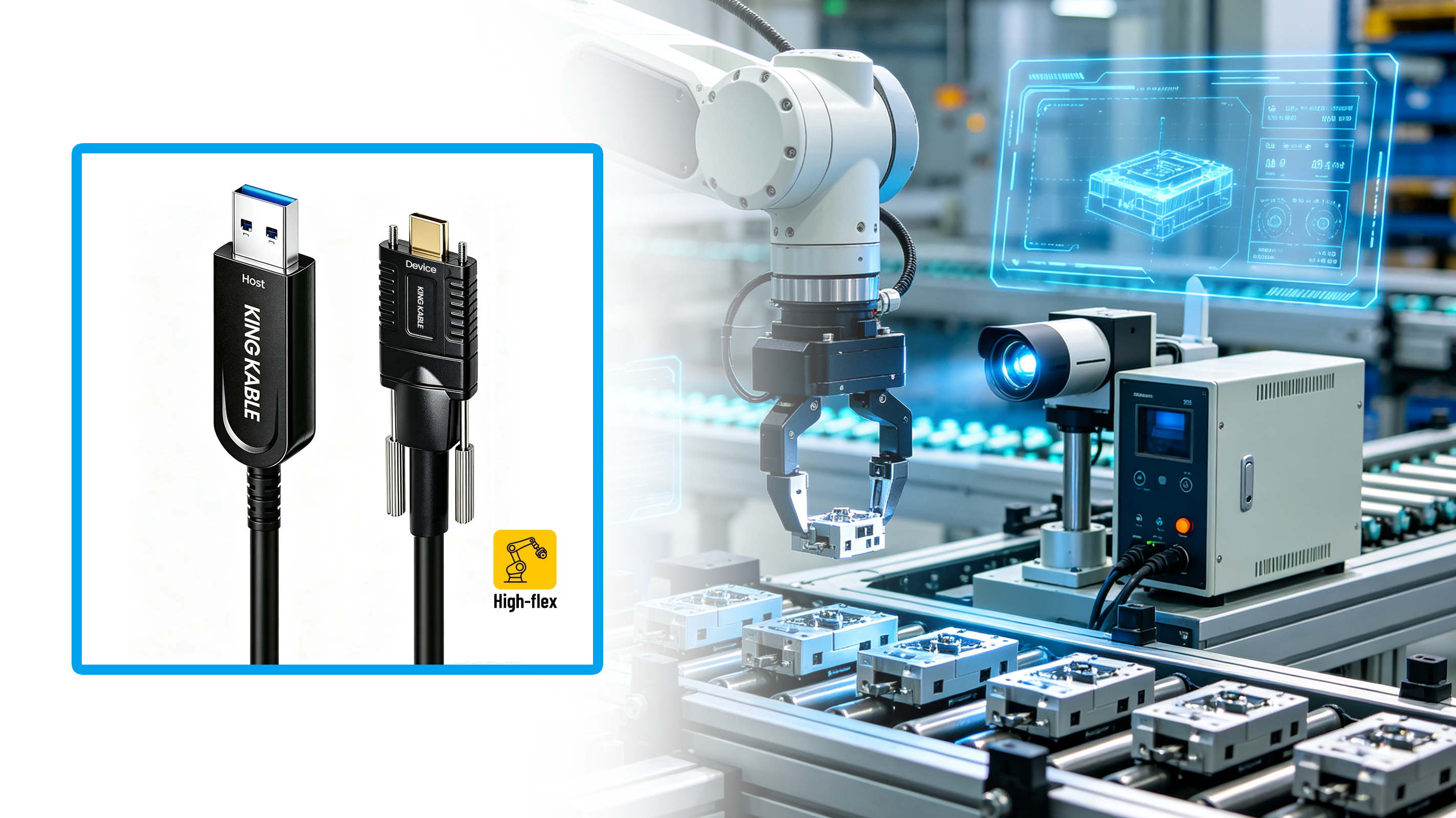
2. Diameter and Bend Radius: The 4.8mm vs 5.5mm Trade-off
The standard cable measures 4.8mm in diameter, optimized for slim routing through conduits, ducts and dense cabinet interiors, with a 50mm static minimum bend radius, tensile ratings of 100N long-term and 200N short-term, and crush ratings of 200N long-term and 400N short-term.
The high-flex drag chain cable measures 5.5mm. The extra 0.7mm is not waste; it is occupied by a thicker jacket, a torsion-resistant braid and the controlled fiber excess-length structure. In a drag chain the cable repeatedly forms an S-shaped bend, so a static bend radius figure cannot describe service life. Reliability depends on fiber strain control under dynamic bending and on jacket fatigue resistance. The drag chain version therefore leaves controlled excess length in the fiber so the glass itself is never stretched when the cable bends.
3. The 10-Million-Cycle Drag Chain Test: Quantifying the Life Difference
The high-flex drag chain cable passes a 10-million-cycle drag chain test (*data from the KING KABLE R&D laboratory). At 5,000 reciprocations per day on a production line, 10 million cycles corresponds to roughly five years of continuous operation. Standard cables are designed for fixed installation and occasional movement; left in a drag chain they develop jacket whitening and cracking from fatigue, while the fiber accumulates micro-bends that raise attenuation and show up as intermittent disconnects or slower device enumeration.
These faults are the hardest to diagnose: the signal drops in and out, swapping the camera changes nothing, and the root cause is eventually traced to the cable itself.
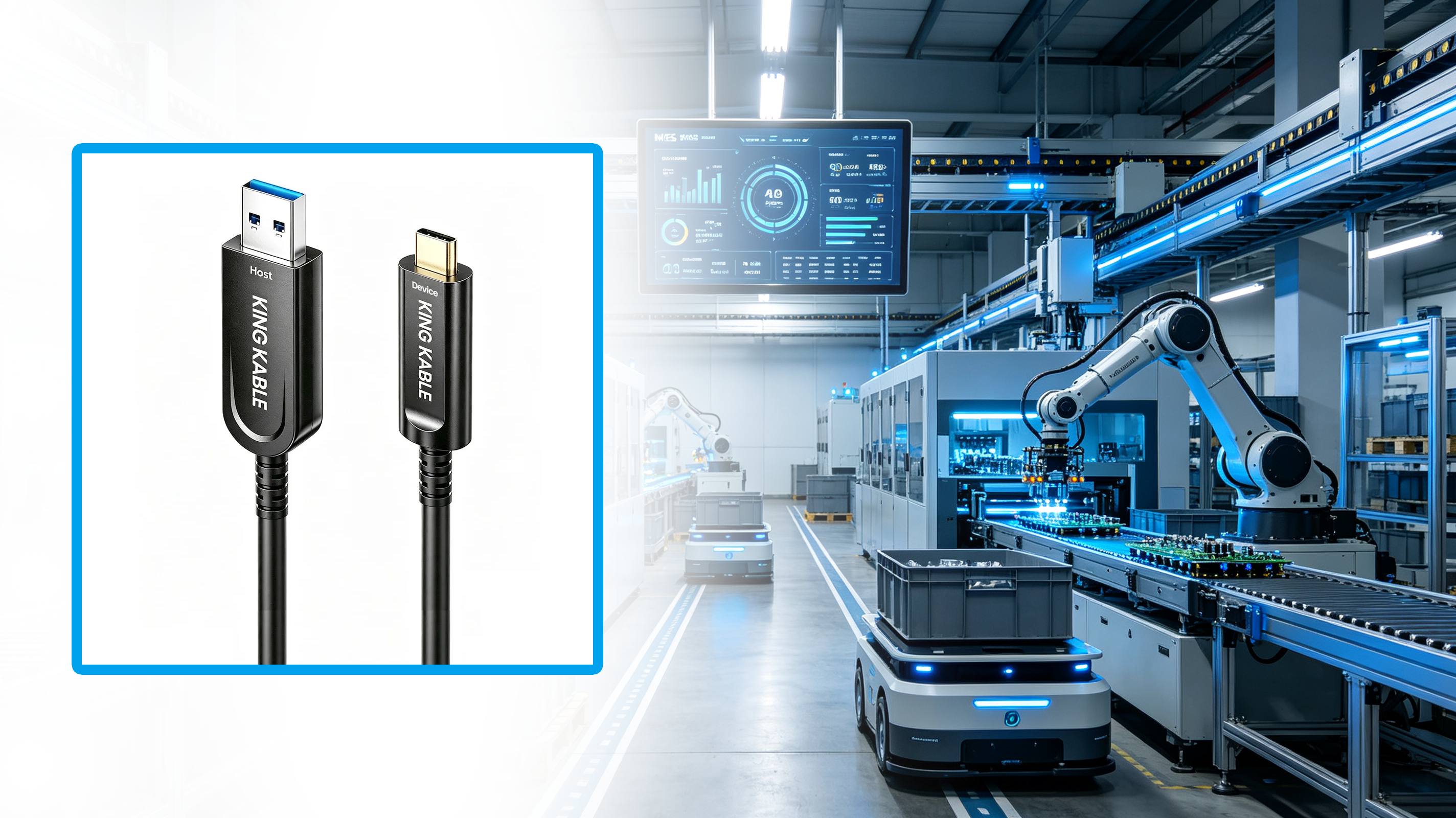
4. Jacket and Core Construction Differences
The standard cable uses an eco-friendly PVC jacket that balances flexibility and cost for indoor fixed environments. The high-flex drag chain cable uses a high-flexibility abrasion-resistant jacket that resists tearing, oil and coolant exposure and tolerates workshop temperature swings. Both reinforce the core with Kevlar (bulletproof silk) yarns for tensile strength, but the drag chain version re-engineers the lay length and fillers for reciprocating motion so cores do not crush against each other and create stress concentrations during bending.
Both retain the inherent advantage of optical transmission: immunity to EMI/RFI from motors, servo drives and frequency converters, delivering lossless signals in electrically noisy plants.
5. Connector Forms and Locking
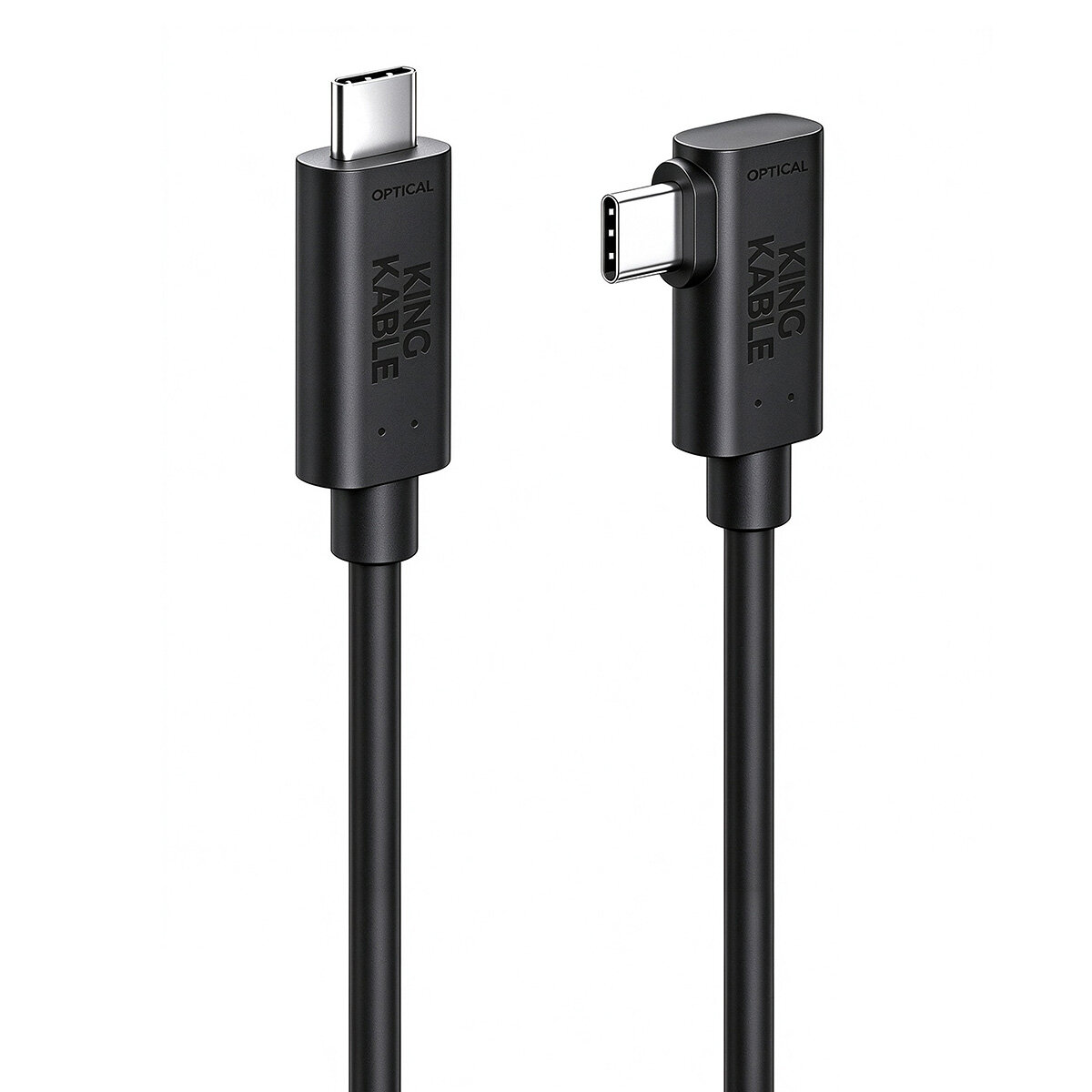
Standard cables typically use lock-free connectors for quick mating, ideal for commissioning and frequent swaps. Drag chain cables are available with locking Type-C connectors that stay firmly mated against vibration and reciprocation, and in straight-plus-angled combinations where the angled end exits flush against the device, saving space inside the drag chain and cabinet while reducing stress on the port.
Selection note: when a connector inside a drag chain is subjected to sustained lateral pull, the locking mechanism usually fails before the cable body does.
6. Selection Advice and Cost Perspective
Choose the standard cable for fixed installations, point-to-point device links, conference engineering, medical imaging, security surveillance, printers and scanners — any static or occasionally moved application where the 4.8mm slim body eases conduit pulling and lowers cost.
Choose the high-flex drag chain cable for CNC machines, vision gantries, pick-and-place robot arms, AGVs, semiconductor equipment, and any application where the cable reciprocates with the mechanism, as well as workshops requiring oil and coolant resistance.
On cost, the drag chain cable carries a higher unit price, yet a single unplanned stop for troubleshooting and replacement usually costs far more than the price gap. Select by motion cycles, not by price — that is the basic rule of automation cabling.
7. Common Myths
Myth 1: "All fiber cables are fragile and cannot go into drag chains." Incorrect. A drag chain cable with controlled excess length and a high-flex jacket passes 10 million reciprocating cycles; breakage risk comes from poor construction, not from the fiber itself.
Myth 2: "Thinner is always better for routing." Not entirely. A slim diameter helps conduit pulling, but in dynamic duty the jacket is thinner and fatigue margin smaller. Slim cables for fixed runs, high-flex cables for drag chains.
Myth 3: "Drag chain cables transmit faster." Incorrect. Both are USB3.1 Gen2 at 10Gbps with identical speed.
To match a specific model to your travel length, speed and bend radius, browse the Fiber Optic USB Cable Series or contact us for selection advice.